
01
Tight tolerances on a small footprint
A ring box has little room for error. The cavity is cut to the piece, and the clearance is confirmed on the physical sample rather than assumed from the drawing.
Industry
Colormix supplies jewelry packaging boxes wholesale from Guangzhou, China: 500 pcs per size, digital digital samples in 3–7 days; production-line samples in 7–10 days; production-line samples in 7–10 days, bulk in 15–22 working days after approval. Small boxes are the hardest to get right — a millimetre decides whether the piece moves — so the dieline and the insert cavity are set before sampling, then produced against the signed sample.
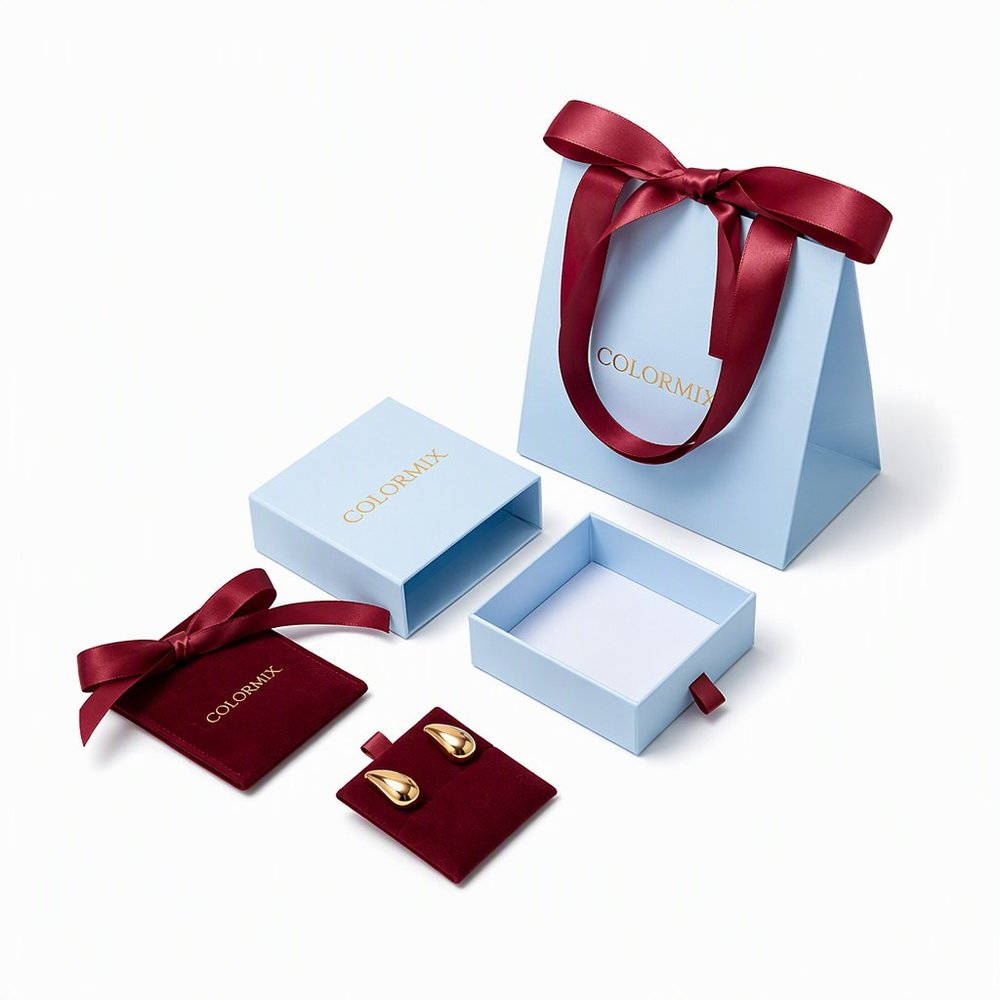
Jewelry packaging works at a small scale, where a millimetre of fit decides whether the piece moves in the box. The box is also part of the product experience: it is opened slowly, often kept, and frequently photographed. Small size does not lower the minimum — it raises the importance of the dieline. Most jewelry packaging boxes are quoted as one set, with the drawer box, pouch and paper bag sharing a single print and finish.
The same structure behaves differently across these three situations. They are the first we ask about.
Small rigid boxes with a velvet or suede interior cut to the piece.
Cartons that double as a display tray behind glass.
A drawer box the customer can close again, so a return arrives intact.
Three structures cover most briefs in this category. Each is quoted per size, from 500 pcs.
Wrapped sleeve with a sliding tray and a ribbon pull — the retail default.
Two-piece box with a foam pad and a recess for a pouch.
For earring cards and pendants sold on a hook.
Four constraints drive most of the decisions here. They are the first things we ask about.
01
A ring box has little room for error. The cavity is cut to the piece, and the clearance is confirmed on the physical sample rather than assumed from the drawing.
02
Jewelry boxes are reused for storage, so hinge strength, lining and lid fit matter more than they do on a carton that is thrown away.
03
A retail counter has limited room. Some brands use a compact box for display and a larger set box for the full purchase, which means two dielines and two minimums.
04
Flocked, satin or suede-effect lining does more for perceived value at this size than a large printed area. Finish and lining are specified together.
Most brands in this category need three or four of these, not one. Each is quoted separately.
| Component | How it is built |
|---|---|
| Ring and earring box | Small rigid box with a hinged or two-piece lid and a flocked or foam cavity. |
| Necklace and bracelet box | Rectangular rigid box with a card platform, ribbon and a cavity for the chain. |
| Watch box | Magnetic or drawer box with a pillow, sized to the case and bracelet. |
| Gift set | Larger rigid box with a multi-cavity tray for a collection, plus a printed sleeve or outer carton. |
Three finishes do most of the work here. The full library, photographed as macros, sits on its own page.
Interior chosen for grip and for the sound of the lid closing.
A thin frame line around a small lid.
Matte surface that does not fingerprint in a shop.
Yes. We cut the cavity from the piece dimensions and confirm the clearance on the physical sample, because a cavity that is 1 mm too tight will mark the product.
Yes. Hinged lids are common for ring and earring boxes. The hinge is built into the board and wrap, and it is tested on the sample for opening resistance.
The 500 pcs minimum applies per size, so four sizes means four minimums. Within one size, one artwork and one insert specification applies.
A pouch costs less and ships flat; a box protects the piece and carries the presentation. Many brands use a box for the main line and a pouch for entry-price items.
Get a packaging quote
Product, channel, quantity and target date is enough to start. You get two or three options with the trade-offs, and an itemised quote.
Last reviewed: 2026-10-26